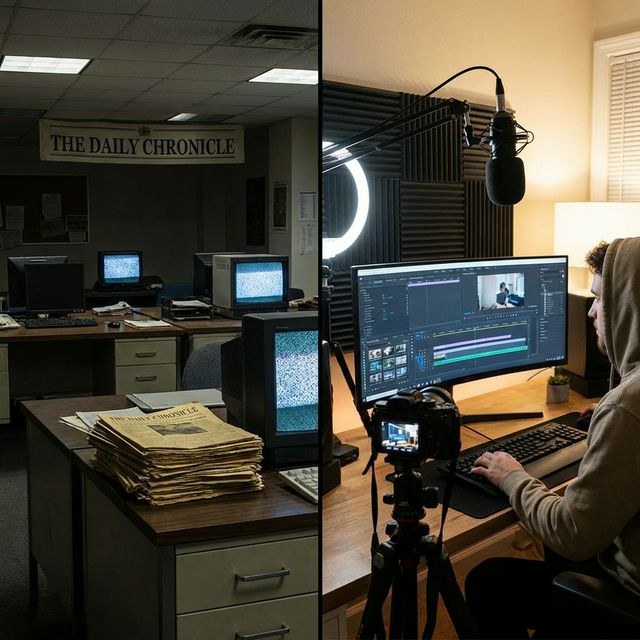
Look around you. A few years ago, most of us switched on the BBC or picked up a newspaper without a second thought. Today, millions are doing exactly the opposite.
Viewership for traditional TV news has crashed from 79 percent to just 48 percent over the last twelve years. Print readership has fallen even harder, down to 12 percent. And trust? In the UK it sits at a miserable 35 percent according to the Reuters Institute’s 2025 Digital News Report, down 16 points since 2015. People are not just drifting away. They are walking out the door and never coming back.
So what is really happening? And why does it matter so much for all of us who care about free speech and real journalism?
The Great Divide: Mainstream vs. New Media
Let me break it down simply. Mainstream media and new independent media are not the same thing. They operate on completely different models, and that difference explains everything.
Mainstream outlets are owned by a handful of huge corporations and billionaires. They have big buildings, expensive studios, layers of editors, and strict editorial lines. Stories get shaped, filtered, and sometimes buried if they do not fit the narrative. They move slowly, rely on official sources, and often seem more interested in protecting powerful interests than telling uncomfortable truths. When they get it wrong, which happens far too often, there is little real accountability beyond a quiet correction buried on page 17.
New media, on the other hand, is anyone with a phone, a laptop, and the courage to speak. It is Mahyar Tousi broadcasting live from the streets with his 1.4 million YouTube subscribers and hundreds of millions of views. It is Tommy Robinson filming what is actually happening in towns the BBC ignores. It is Dan Wootton running his Outspoken show straight to the audience without gatekeepers.
"These creators are funded directly by their viewers through subscriptions, donations, and loyalty, not by corporate advertisers. If they lose touch with their audience, they lose everything. That keeps them honest and fast."
Why the Shift is Happening Now
The result is clear. People are fed up with being talked down to. They want news that covers the issues that actually affect their lives—immigration, grooming gangs, free speech crackdowns, the cost of living—without the spin. They want it in real time, not hours or days later. And they want to be able to comment, question, and hold the reporter accountable. New media gives them all of that. Mainstream media does not.
This shift is not some mysterious trend. It is a direct reaction to years of bias, group-think, and outright failure. When mainstream outlets spent years downplaying grooming scandals until independent voices forced the issue into the open, trust collapsed. When they pushed narratives on COVID, migration, or politics that large parts of the public could see did not match reality, people switched off. Add in endless scandals, falling ad revenue, and the fact that social media now lets anyone bypass the old gatekeepers, and you have the perfect storm.
A healthy democracy needs diverse voices and real scrutiny of power. When one side of the story dominates, we all lose. Independent journalists and citizen reporters act as the true public watchdogs today. They expose what the big players miss or deliberately ignore. They give ordinary people a platform. And they prove that you do not need a fancy press card or a corporate salary to do proper journalism. All you need is integrity and a willingness to tell the truth.
Protecting the Right to Report
Which brings me to something we must protect fiercely: the right of every single one of us to be part of this new media world.
In the UK, our freedoms are not gifts from the government. They are protected in law. The big one is Article 10 of the European Convention on Human Rights, brought into UK law through the Human Rights Act 1998. It says everyone has the right to freedom of expression. That includes the freedom to hold opinions and to receive and impart information and ideas without interference by public authority. It applies to journalists, citizen journalists, bloggers, YouTubers, everyone. The European Court has repeatedly said this right is vital for public debate and that citizen journalism on the internet plays a crucial role in democratic society.
There is no special licence required to be a journalist in this country. You do not have to register with anyone or pass a test. If you are reporting in the public interest, data protection laws give you important exemptions. Journalistic material gets extra protection from police seizure under the Police and Criminal Evidence Act. And the courts have made it clear that even small, informal groups or individuals acting as watchdogs deserve strong Article 10 protection.
These rights are what give ordinary people the power to become the new media. They are what let Mahyar Tousi, Tommy Robinson, Dan Wootton and thousands of others do their work. And they are what we must defend whenever governments or big tech try to restrict them through vague “online safety” rules, deplatforming, or pressure on platforms.
A New Era for Journalism
At Independent Media Alliance, we exist precisely to champion and protect this space. We believe in a free, open, and plural media where truth can compete in the marketplace of ideas. We know the mainstream model is dying because it stopped serving the public. We also know the independent model is thriving because it does.
So if you have had enough of the old guard, start supporting the new voices. Subscribe, share, donate where you can. Pick up your phone and start reporting yourself. Exercise those Article 10 rights every single day. The future of journalism does not belong to the big corporations anymore. It belongs to all of us.
The mainstream media is not just declining. It is being replaced by something better, more honest, and more democratic. And that is a story worth telling.