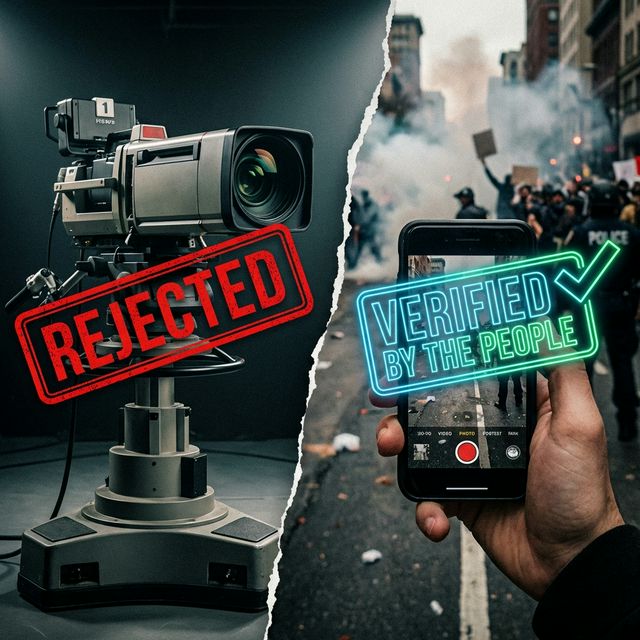
For decades, the high priests of the mainstream media have preached from their pulpits about a mythical concept called "objectivity." They’ve sat in their climate-controlled studios, wearing expensive suits, and told us that a "real" journalist is a neutral observer—someone who stands perfectly in the middle, emotionless, just "reporting the facts."
But we know the truth. That "objectivity" is a lie. It is a convenient mask used by legacy outlets like the BBC and Sky to hide their own deep-seated biases. When they choose which stories to cover and which to ignore, that isn't neutral. When they use loaded language to describe patriots while softening their tone for the establishment, that isn't objective.
At the Independent Media Alliance, we believe the line between activism and documentation isn't just blurry—it’s often non-existent. And more importantly, we believe that’s exactly how it should be.
The Weaponization of the "Activist" Label
If you are a citizen journalist standing on a street corner in London or Leeds, filming a protest that the mainstream media is ignoring, you will eventually be hit with the "activist" label. The police will use it to justify moving you on. The legacy press will use it to dismiss your footage. They want to put you in a box labeled "political agitator" so they don't have to deal with the uncomfortable truths you are capturing on your lens.
Why do they do this? Because an "activist" is easy to dismiss. An "activist" can be painted as a fringe element, a troublemaker, or someone with an "agenda." By contrast, they reserve the title of "Journalist" for themselves—the protected class who have the "correct" credentials and play by the "correct" rules.
But here is the reality they don't want you to know: Documentation is an act of defiance. In a world of state-sponsored spin and corporate censorship, simply showing up with a camera and refusing to look away is a radical act. If documenting the truth makes you an activist, then every great journalist in history was one too.
The Myth of the Neutral Observer
Let’s be honest about what we do. When an independent reporter goes to a migrant center or a high-stakes protest, they aren't there because they are neutral. They are there because they care about the truth. They are there because they believe a story is being suppressed.
The mainstream media loves to talk about "balance." They’ll give five minutes to the truth and five minutes to a lie and call it "fairness." We don't do that. Our "bias" is toward the facts that the establishment wants to bury. If you are documenting an injustice, you aren't supposed to be neutral. You are supposed to be truthful.
There is a fundamental difference between bias and honesty. A biased reporter hides their perspective to manipulate the audience. An honest reporter—like the ones we champion at the Independent Media Alliance—tells you exactly where they stand and then shows you the raw, unedited footage so you can decide for yourself. That is far more "objective" than any heavily edited package you’ll see on the evening news.
The Legal Shield: Article 10 Doesn't Discriminate
The establishment tries to claim that "journalistic protections" only apply to the "neutral" press. They are wrong.
Under Article 10 of the European Convention on Human Rights (ECHR), your right to impart information is protected regardless of your political stance. The law does not say "freedom of expression is only for those who are impartial." In fact, the European Court has been very clear: Article 10 protects not just the information that is favorably received, but also that which "offends, shocks, or disturbs."
When the police tell a citizen journalist to stop filming because they are "just an activist," they are demonstrating a dangerous ignorance of the law. Your intent—whether you want to change the world or just record it—does not strip you of your rights. Whether you are Mahyar Tousi, Tommy Robinson, or a grandmother with an iPhone, if you are gathering news for public consumption, you are performing a journalistic function.
The UK courts have recognized that "purposeful" journalism—journalism with a point of view—is still journalism. The act of documentation is the gathering of evidence. The fact that the evidence supports a specific "activist" viewpoint doesn't make the evidence any less real.
Why Documentation is the Ultimate Activism
We are living in an era where the government and big tech are desperate to control the "narrative." They use "fact-checkers" (who are often just activists for the status quo) to suppress independent voices. They use the Online Safety Act to chill free speech.
In this environment, the most effective form of activism is simply documentation.
- You don't need to write a manifesto; you just need to press "record."
- You don't need a degree in journalism; you just need to be there when the mainstream isn't.
- You don't need permission; you have Article 10.
When you document a police interaction, a political rally, or a community in decline, you are creating a record that cannot be erased by a corporate editor in London. You are providing the "primary source" material that allows the public to bypass the gatekeepers. That is why they fear you. They don't fear your opinions; they fear your camera.
The Future of the Independent Media Alliance
The Independent Media Alliance was founded on the belief that the era of the "neutral" gatekeeper is over. We don't want sanitized news. We want the raw, unfiltered truth from people who actually have skin in the game.
We will never apologize for being "activists" for the truth. We will never stop defending the right of every citizen to pick up a camera and hold power to account. The line between activism and documentation isn't a wall; it's a bridge. And on that bridge is where the future of a free press lives.
The mainstream media is a sinking ship, weighed down by its own arrogance and its subservience to the state. Independent media is the lifeboat. We might be messy, we might be passionate, and we certainly aren't "neutral"—but we are the only ones left telling the truth.
Stop asking for permission to be a journalist. Start documenting. The truth doesn't need a license; it just needs a witness.